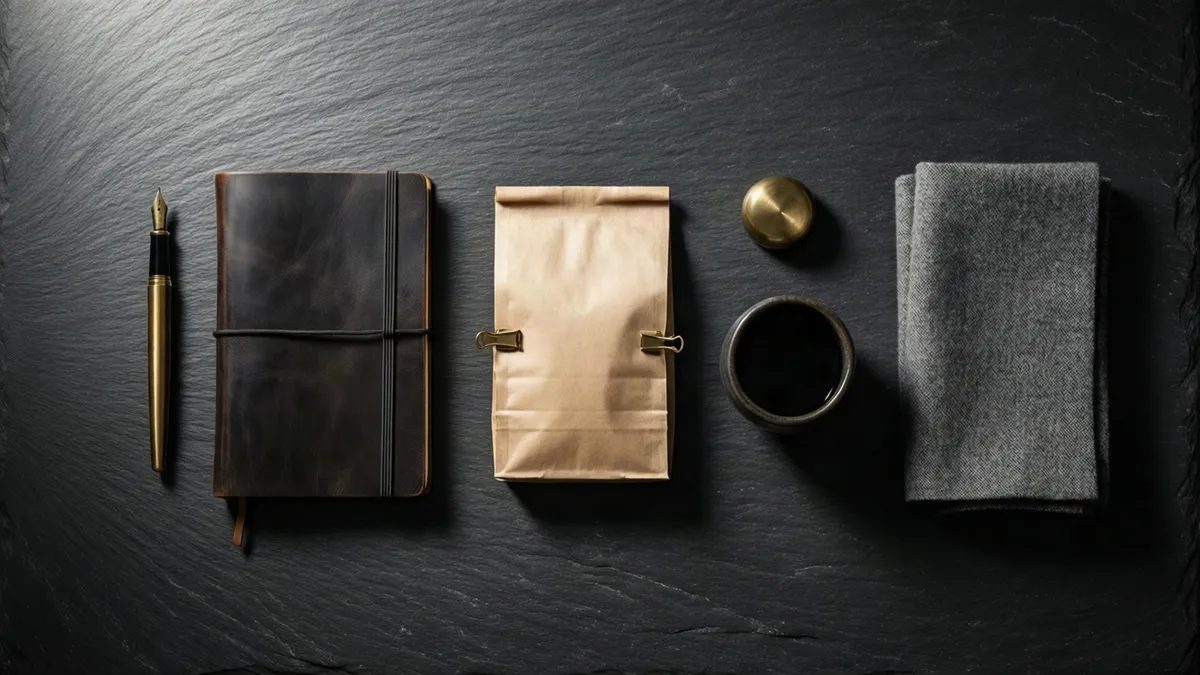
In short: every pick on this page is argued from something a manufacturer, a standards body or a federal agency has published. Coffee is chosen on freshness figures, drinkware on whether a retention claim carries its test conditions, a gift card on federal fee and expiry rules. Where nothing has been published, this page says so and declines to argue.
We write buying guides, not lab reviews. Nothing here has been tested, handled or priced by us, and prices, availability and ratings change constantly — whatever Amazon shows when you click is the authoritative figure. On what a gift may cost, check your employer's gift policy: that is the only ceiling that applies to you.
Most roundups in this category rank by enthusiasm. A writer likes a mug, calls it the best mug, and the reader is asked to accept taste as evidence.
That does not work when the recipient signs off on your raise. The gift will be opened in front of the team, and the only defensible reason to have chosen it is a reason you can point at.
So this page uses a narrower test. Every pick below has to rest on a published specification. A number a manufacturer committed to in writing. A standard a body actually issued. A figure a federal agency printed. Nine categories clear that bar. Several popular ones do not, and they are listed at the end.
Many employers cap or prohibit gifts to a manager, and public-sector and regulated workplaces have written rules. Check your own employer's policy before you spend anything — that policy, not this page, is the ceiling that applies to you.
What "best" cannot mean here
A group gift is only a group gift if contributing was genuinely optional. Ask once, in writing, with an amount people can decline without explaining, and put the whole team's name on the card.
Two definitions have to go before the picks make sense.
Best cannot mean expensive. Upward gifts get worse as they get more expensive, which is the restraint rule the pillar page argues in full. Notice what that is: an etiquette claim, made by this site, about how a room reads a price tag.
It is not sourced, and nothing in the material behind this article supports a dollar figure. No manufacturer, standards body or agency consulted here publishes a number for what a gift to a manager should cost. Any roundup quoting an average spend invented it or borrowed it from somebody who did.
Best cannot mean enthusiasm either. A pick you cannot defend is a guess with confidence attached, and confidence is the cheapest thing on the internet.
What remains is narrow and useful: pick the thing whose maker has told you something checkable, then check it.
This article contains affiliate links. If you buy through one, we earn a small commission at no extra cost to you. We only recommend what we would suggest to a friend. Our full affiliate disclosure sets out how that works.
Coffee: a small bag, recently roasted
Coffee is the category where the published evidence is clearest, which is why it opens this list.
The National Coffee Association (NCA) prints shelf-life figures. At room temperature, whole beans hold their freshness for one to three weeks and ground coffee for one to two. Frozen whole beans keep three to four months.
The association also states that coffee "begins to lose freshness almost immediately after roasting."
Hold those two facts together and the usual gift collapses. A large decorative tin of pre-ground coffee is already at the short end of the shorter window on the day you wrap it, and it was ground weeks before that.
The NCA's own advice runs the other way. Buy smaller batches of freshly roasted coffee, roughly a week or two's worth. Wait to grind. Store in an airtight container, and an opaque one, because "clear canisters let in light, which can compromise the taste of your coffee."
That is a gift you can specify out loud: one small bag, whole beans, roast date printed on the bag, bought close to the day you hand it over. Compare whole bean coffee sampler sets on Amazon and read the roast date before anything else on the listing.
The advice does imply a grinder, and this is where the site's own rule overrules the evidence. Equipment tells someone their current method is wrong, which is why the pillar leaves grinders off.
One further note on attribution, because coffee writing is full of borrowed numbers. The Specialty Coffee Association's Golden Cup criteria specify a brew strength of 11.5 to 13.5 grams per liter of total dissolved solids. The extraction yield given is 18 to 22 percent. That wording reaches this page quoted verbatim by Moccamaster, a certified manufacturer. The association's own numeric standards sit behind a member portal, so a manufacturer's quotation is the honest citation to make.
Tea: an international standard that will not help you brew
There is an international standard for making tea. It is worth knowing what it is, mostly so you stop seeing it misused.
The International Organization for Standardization (ISO) publishes ISO 3103:2019, "Tea — Preparation of liquor for use in sensory tests." The second edition was published in December 2019 and replaced the 1980 original.
Its abstract describes a method for preparing tea liquor "for use in sensory tests, by means of infusing the leaf." That is a laboratory comparison protocol. It exists so that two tasters assessing two samples are comparing leaf against leaf, with technique held constant.
It is not a brewing chart, and it was never written to tell you how to make a cup.
The trade publishes something more useful, and it is qualitative. Upton Tea Imports specifies water "that has just come to a rolling boil" for black teas, "near the boiling point" for oolong, and "less than boiling" for green and white. Its measure is a teaspoonful per cup, and it notes that steeping time depends on the leaf type and grade.
Rishi Tea, writing in October 2023, gives the reason temperature matters at all: the wrong water temperature "can cause an over extraction or under extraction of polyphenols (tannins)." Its page adds that herbal infusions cannot be burned this way, because they carry no tannins.
Neither importer publishes a per-type temperature table, and neither does this page. If you have read "175°F for green, 195°F for oolong" somewhere, that number came from a vendor blog, not from a standard.
Buy the leaf and let the recipient work it out. A loose leaf tea sampler on Amazon offers a choice instead of imposing one, which is the whole reason samplers work as upward gifts.
Insulated drinkware: read the footnote, not the headline
Every vacuum flask on the market claims to keep drinks hot. Almost none of them tells you under what conditions, and that difference is the entire pick.
Zojirushi publishes both. For its Stainless Mug SM-KHE36, the 12-ounce size, heat retention is given as 185°F at one hour and 147°F at six hours. The 16-ounce SM-KHE48 is listed at 187°F and 154°F over the same intervals. Cold retention for both is 48°F at six hours.
Then comes the footnote that makes those numbers mean anything. The rating is based on water at a starting temperature of 203°F in a room at 68°F, and the cold rating on water starting at 40°F in the same room.
A retention figure without a start temperature and an ambient is not a specification. It is a sentence.
YETI takes the opposite route and is admirably direct about it. Its Rambler FAQ states that "due to all the variables that can affect ice retention, we can't guarantee a precise amount of time." Its cold claim is comparative only: the tumblers stay cold twice as long as plastic cups.
Both companies are being honest. One publishes numbers with their conditions attached; the other declines to publish numbers at all. Both are more trustworthy than a listing promising twenty-four hours with no test method anywhere on it.
The buying instruction follows directly. Choose from vacuum insulated travel mugs on Amazon whose maker publishes retention figures with their test conditions, or whose maker says plainly that it will not.
Care instructions work the same way. Zojirushi's page for that mug carries no dishwasher statement; YETI states that all Rambler products are dishwasher safe. Check the maker's own care note, because it differs by brand and even by lid.
A pen, because the refill is standardized
"Refillable" is the word every pen listing uses. A standard is what turns it into a claim you can check.
ISO 12757-2:1998 covers "Ball point pens and refills — Part 2: Documentary use (DOC)." It sets minimum quality requirements for ball point pens, refillable or not, and for the refills themselves. Part 1 handles general use. Both were prepared by ISO Technical Committee 10.
The practical consequence is the reason a pen has survived as an office gift. A refill built to a published standard can still be bought in ten years, from someone other than the original maker. The gift does not quietly become disposable when a proprietary cartridge is discontinued.
This page will not print refill dimensions. ISO's public listing for 12757-2 gives the title, scope, edition and date — not millimetres. Every dimension circulating online traces back to retailer listings, and none of it is sourced here.
Fountain pens sit outside that standard entirely, so no standards claim is made about them. Refillable fountain pens on Amazon are a taste decision, argued on the same logic by analogy, with no document behind it.
Leave the engraving off, whichever you choose. A monogram from a subordinate makes the object impossible to pass on.
A notebook: grammage is the number they commit to
Paper marketing is almost entirely adjectives. There is one exception, and it is worth building the pick around.
LEUCHTTURM1917 publishes "80–100 gsm FSC-certified paper" on its hardcover notebook page. That is grammage — grams per square metre — and it is the single specification a notebook manufacturer will put in writing.
Note what the page does not say. It makes no bleed-through claim, no ink-proof claim, and no promise about fountain pen behavior.
So this page does not tie grammage to bleed-through either. Nothing in the sourced material supports the widely repeated threshold, and bleed-through depends on paper sizing and the ink as much as on mass per unit area.
Use gsm for what it honestly is: evidence that a manufacturer measured something and published the result. Among hardcover notebooks on Amazon, the ones that print a grammage figure are the ones telling you anything at all.
A desk plant, for a room with no window
Most plant recommendations assume a windowsill. Plenty of managers work in an interior office with fluorescent light and nothing else, and there is published guidance for exactly that.
The University of Illinois Extension, writing in January 2023, states that houseplants "grow well, even thrive, in low-light rooms." The key to success, it adds, is choosing the right plant for the right place. Low light in practice means near an east or north-facing window, or several feet from a window with no direct light.
One entry on its list settles the windowless case. ZZ plants "grow best in low, indirect light, but also grow under fluorescent lighting," and want water only every two to three weeks.
That last detail matters more than the light. A gift plant on a manager's desk will be travelling, in meetings, and away for a week at a time. A plant that resents a missed watering is a gift that dies in public.
The Extension names a snake plant as growing in a room with very little natural light, preferring to dry out completely between waterings. Peperomia, Chinese evergreen, pothos, cast iron plant and peace lily appear on the same list.
Buy a ZZ plant in a plain pot on Amazon and skip the decorative planter, which is a taste guess wearing a plant.
There is a second, sharper use for the plant evidence: ruling something out. The USDA Plant Hardiness Zone Map, released November 15, 2023 and built on 1991–2020 climate normals, divides the United States and its territories into 13 zones and half zones. It governs whether a perennial survives a winter outdoors.
Which means the listicle staple of gifting a tree, without knowing where the recipient lives, is unsupported by the map people invoke to justify it. A planted tree is a retirement-scale gesture in any case, and the occasion that actually carries it is its own page.
Packaged food, because the label is the specification
Consumables are the safest category in upward gifting. Within it, packaging is a specification difference, and not a matter of taste.
The Food and Drug Administration (FDA) recognizes nine major food allergens: milk, eggs, fish, crustacean shellfish, tree nuts, peanuts, wheat, soybeans, and sesame. Sesame became the ninth under the FASTER Act, signed April 23, 2021, effective January 1, 2023.
The labeling mechanics are prescribed. A major allergen's food source must appear in parentheses after the ingredient — "lecithin (soy)," "flour (wheat)," "whey (milk)" — or in a "contains" statement next to the ingredient list.
Now the two exclusions that decide the gift.
Those requirements do not extend to most foods sold at retail or food service that are not pre-packaged with a label. And advisory statements of the "may contain" variety are not required by law at all.
A sealed, labeled box of confectionery therefore declares what is in it, by federal requirement. The unpackaged bakery box and the artisan counter case do not, however good they are. If you do not know the recipient's allergies — and you probably do not — that is the difference, and it rests on a document.
For the same reason, the etiquette filters that govern food gifts generally are the appropriateness question, not a labeling one.
Lighting and monitor height: the federal figures
Two objects on this list can be argued from numbers the federal government has actually printed, which is rarer than the office-gift genre implies.
Light. OSHA — the Occupational Safety and Health Administration — sets minimum illumination intensities in 29 CFR 1926.56, Table D-3. Offices, first aid stations and infirmaries are listed at 30 foot-candles while work is in progress. General construction area lighting is listed at 5.
Read the citation before you use the number. That is the Construction standard, and the table descends from American National Standard A11.1-1965, R1970. The honest framing is that the only place the federal government puts a figure on office light is a construction regulation, and the figure there is 30 foot-candles.
Monitor geometry. OSHA's Computer Workstations eTool is more directly useful. It states that "the preferred viewing distance is between 20 and 40 inches (50 and 100 cm) from the eye to the front surface of the computer screen."
It adds that the center of the monitor "should normally be located 15 to 20 degrees below horizontal eye level." The top of the screen belongs at or slightly below eye level, and the downward viewing angle should never exceed 60 degrees. On glare, it recommends tilting the screen no more than 10 to 20 degrees, and placing the monitor perpendicular to a window.
A laptop sitting flat on a desk cannot meet that geometry. Its screen and its keyboard are attached, so raising one lowers the other.
That is the argument for a riser or a stand, and it is the only desk-accessory pick on this page with a federal target behind it. It also stays neutral, which matters: it improves the desk without commenting on the person at it.
A gift card, protected by regulation
The objection to a gift card is that it is impersonal. The case for one, from a team, is that it is the only pick here whose terms are set by federal regulation rather than by a manufacturer.
The Consumer Financial Protection Bureau (CFPB) publishes Regulation E, § 1005.20, implementing the Credit CARD Act of 2009.
Three provisions carry the argument. Under § 1005.20(e)(2), the underlying funds must not expire earlier than the later of five years from issuance or last load, or the printed expiration date. Under § 1005.20(d)(1), a dormancy, inactivity or service fee may be imposed only where there has been no activity in the year ending on the date of the fee. Under § 1005.20(d)(3), no more than one such fee may be imposed in any calendar month.
The money keeps for years, and a dormancy or service fee cannot be charged inside the first year of activity. That is a floor set in federal regulation, and it is more than any object on this page comes with.
Two limits on the claim. This is federal law only, states add their own overlays, and no state-by-state compilation was reviewed for this article. And the regulation is addressed to issuers, not to you.
From a group the card also solves the sender problem, because the collection mechanics put every name on the envelope. The same holds for a modest card on October 16, where the smallest workable gesture is usually the right one.
A donation in the manager's honor is the adjacent option, with one thing worth stating. IRS Publication 526 is clear that the person making the contribution to a qualified organization is the one who may deduct it. Contributions to specific individuals are not deductible at all.
Where no specification exists, this page declines
The picks above are the ones that survived. Here is what did not, because saying so is the point of the exercise.
- A per-tea steeping temperature chart. No standards body or importer consulted publishes one. ISO 3103 is a sensory-lab method, and the importers give language rather than degrees.
- Ballpoint refill dimensions. ISO's public page for 12757-2 lists title, scope and edition, with no measurements.
- A grammage threshold for bleed-through. Not published by any manufacturer or standards source consulted, and dependent on ink and sizing regardless.
- Retention hours for any brand that does not publish test conditions. YETI declines to guarantee a duration, and the roundups that print one for it are not quoting YETI.
- A hardiness zone for an indoor plant. The USDA map governs outdoor perennial survival and says nothing about a desk.
- A price, a rating or a review count. None was collected. Prices move, ratings move, and neither belongs in a page that will sit here for years.
One more, for completeness. The General Services Administration publishes P100, "Facilities Standards for the Public Buildings Service," dated May 2024, and it does contain interior lighting requirements. Its lighting section was not read for this article, so the widely quoted figures attributed to it appear nowhere above.
The general rule this page runs on: an absent specification is information. It tells you the distinction you were about to make is one nobody has bothered to document, which usually means it does not decide anything.
FAQ
What is the best gift for a boss?
A small bag of recently roasted whole bean coffee is the strongest default. The National Coffee Association's published freshness figures give one to three weeks at room temperature for whole beans, and one to two for ground. That argues for a small, fresh bag over a decorative bulk tin. A modest gift card from the team is the alternative, since federal regulation keeps the funds valid for at least five years.
Is an expensive gift better for a manager?
No, and nothing sourced for this page supports a dollar figure in either direction. The reason to keep an upward gift modest is social. Colleagues who did not spend the money can read the price, and the manager has to respond to it in public. Restraint is an etiquette argument, made here as one, and the pillar page works through it in detail.
How do you choose an insulated mug that actually works?
Look for a retention claim with its test conditions attached. Zojirushi publishes hours, start temperature and ambient room temperature for its Stainless Mug SM-KHE line. YETI states outright that it cannot guarantee a precise ice-retention time. A listing that names a number of hours with no start temperature and no ambient is not quoting a test.
Is a plant a safe gift for an office with no windows?
A ZZ plant is the defensible choice. The University of Illinois Extension states that ZZ plants grow best in low, indirect light and also grow under fluorescent lighting, needing water only every two to three weeks. Hardiness zones do not apply here; the USDA map governs plants living outdoors.
Why does packaged food beat a bakery box as a gift?
Because of what the label is required to carry. The FDA requires packaged foods to declare the nine major food allergens, either in parentheses after the ingredient or in a "contains" statement. Most foods sold at retail or food service without a package and label fall outside that requirement, and "may contain" advisories are not required by law at any time.
Does a gift card expire before it gets used?
Federal rules set a floor. Under 12 CFR § 1005.20(e)(2), as the CFPB publishes it, the funds must remain good for at least five years from issuance or from the last load. Fees are limited too: no dormancy or service fee where there has been activity in the past year, and no more than one such fee per calendar month. State law may add to this, and none was reviewed here.
Sources
- National Coffee Association USA, "Storage and shelf life," published August 14, 2024, modified November 11, 2024, https://www.aboutcoffee.org/beans/storage-and-shelf-life/ — retrieved 2026-08-20.
- National Coffee Association USA, "Drip coffee," no date shown, https://www.aboutcoffee.org/brewing/drip-coffee/ — retrieved 2026-08-20.
- Moccamaster USA, "What is the Golden Cup standard?" (quoting the Specialty Coffee Association), no date shown, https://support.moccamaster.com/hc/en-us/articles/1500009409121-What-is-the-Golden-Cup-standard — retrieved 2026-08-20.
- International Organization for Standardization, "ISO 3103:2019 — Tea — Preparation of liquor for use in sensory tests," Edition 2, December 2019, https://www.iso.org/standard/73224.html — retrieved 2026-08-20.
- Upton Tea Imports, "How to Steep Loose Leaf Tea," no date shown, https://www.uptontea.com/pages/how-to-steep-loose-leaf-tea — retrieved 2026-08-20.
- Rishi Tea, "Why Water Temperature is Important When Brewing Tea," October 1, 2023, https://rishi-tea.com/blogs/journal/why-water-temperature-is-important-when-brewing-tea — retrieved 2026-08-20.
- Zojirushi America Corporation, "Stainless Mug SM-KHE36/48" product page, no date shown, https://www.zojirushi.com/app/product/smkhe — retrieved 2026-08-20.
- YETI, "Rambler FAQ" (EU site), no date shown, https://eu.yeti.com/pages/rambler-faq — retrieved 2026-08-20.
- International Organization for Standardization, "ISO 12757-2:1998 — Ball point pens and refills — Part 2: Documentary use (DOC)," Edition 1, May 1998, https://www.iso.org/standard/23718.html — retrieved 2026-08-20.
- LEUCHTTURM1917 (US), "Hardcover Notebook" product page, no date shown, https://www.leuchtturm1917.us/products/hardcover-notebook — retrieved 2026-08-20.
- University of Illinois Extension, Brittnay Haag, "Brighten up dim interiors with low-light houseplants," January 13, 2023, https://extension.illinois.edu/blogs/flowers-fruits-and-frass/2023-01-13-brighten-dim-interiors-low-light-houseplants — retrieved 2026-08-20.
- USDA Agricultural Research Service, "USDA Unveils Updated Plant Hardiness Zone Map," November 15, 2023 (page last modified October 1, 2024), https://www.ars.usda.gov/news-events/news/research-news/2023/usda-unveils-updated-plant-hardiness-zone-map/ — retrieved 2026-08-20.
- U.S. Food and Drug Administration, "Food Allergies," content current as of March 11, 2026, https://www.fda.gov/food/nutrition-food-labeling-and-critical-foods/food-allergies — retrieved 2026-08-20.
- U.S. Occupational Safety and Health Administration, "29 CFR 1926.56 — Illumination," Table D-3, no date shown, https://www.osha.gov/laws-regs/regulations/standardnumber/1926/1926.56 — retrieved 2026-08-20.
- U.S. Occupational Safety and Health Administration, "Computer Workstations eTool — Monitors," no date shown, https://www.osha.gov/etools/computer-workstations/components/monitors — retrieved 2026-08-20.
- U.S. General Services Administration, "P100 Facilities Standards for the Public Buildings Service," May 2024, https://www.gsa.gov/system/files/P100%202024%20Final%20(1).pdf — retrieved 2026-08-20 (cited for its existence and date; its lighting section was not read for this article).
- Consumer Financial Protection Bureau, "§ 1005.20 Requirements for gift cards and gift certificates," Regulation E, no date shown, https://www.consumerfinance.gov/rules-policy/regulations/1005/20/ — retrieved 2026-08-20.
- Internal Revenue Service, "Publication 526 (2025), Charitable Contributions," 2025 edition, https://www.irs.gov/publications/p526 — retrieved 2026-08-20.
Sourcing and assembly by Adrienne Locke. Every figure above was read at the publisher's own address on August 20, 2026. Where a figure could not be read there, the page says so instead of borrowing it. The method is on the about page and the commercial arrangements in the affiliate disclosure. The catalog is at gift picks; everything else is in articles.